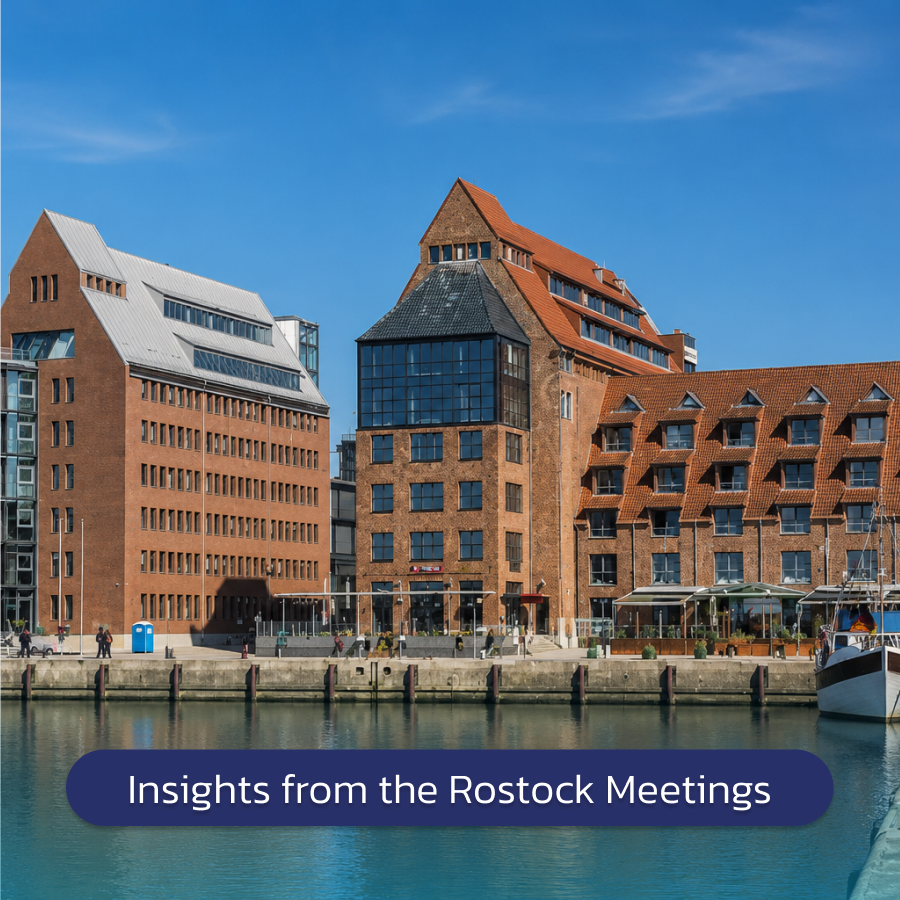
Healthcare stakeholders come together in Rostock
Rostock recently again brought together stakeholders from across healthcare, research, patient representation, politics, regional development, innovation and business. The meetings provided valuable perspectives on the future of healthcare, digital health, the European Health Data Space, regional healthcare ecosystems and – most important – collaboration between the different players and how to strengthen it.
Kalms Consulting was represented by Dr. Stephan Binder, Co-Founder and CEO, providing an opportunity to connect and exchange perspectives.
Building the European Health Data Space together
The first event, Building the EHDS Together: Empowering Patients, Strengthening Regions, focused on the implementation, opportunities and challenges of the European Health Data Space, EHDS. Organised by DIG-in-HEALTH, BioCon Valley GmbH, ScanBalt BioRegion and the NDGR – Netzwerk Deutsche GesundheitsRegionen e. V., the symposium also marked the 25th anniversary of ScanBalt.
A central theme of the event was the effective and trusted use of health data. The discussions made clear that health data play an important role in improving patient care, supporting research, enabling innovation and increasing efficiency across healthcare and life sciences. This is relevant in all areas including rare diseases, where better data availability can help researchers work faster and support more effective development pathways.
What stood out was the multi-perspective approach. The symposium included regulatory and industry perspectives but also placed strong emphasis on the patient perspective and the role of regional ecosystems (focussing on impact as well as practical implementation). This broader view is essential, as the successful implementation of the EHDS will require active engagement from stakeholders across the healthcare system.
A particular highlight was the keynote by Karlheinz Steinmueller from Z_punkt The Foresight Company, titled “What is European Health? A View of the Futurist”. The keynote offered a forward-looking perspective on how European healthcare may develop in a more connected, data-driven and patient-oriented environment.
Networking and new connections at Ship-to-Business
In the evening, the focus shifted to the Ship-to-Business Networking Event, where startups, investors, service providers and other stakeholders met in a more informal setting on a boat between Rostock and Warnemünde. Dr. Stephan Binder used the opportunity to connect with founders, innovation partners and ecosystem representatives as well as with the participants of a delegation from this year’s partner country Latvia in a more open networking format. The event created a unique atmosphere for pitch presentations, discussions, networking and new connections.
The National Conference on Health Economy 2026
On the next day, June 11th, 2026, the 21st National Conference on Health Economy 2026 started. Over 600 national and international experts met for this two-day conference organized by BioCon Valley® GmbH, the health economy network for Mecklenburg-Vorpommern, on behalf of the state government of Mecklenburg-Vorpommern. The key topics addressed the central challenges that healthcare systems are currently facing. From innovation, medical technology and artificial intelligence to prevention and fitness in the context of longevity, as well as the promotion of startups, this year’s event offered a wide range of dialogues and formats.
Particularly interesting insights were shared in the session “Technology for Resilience: The Health Economy between politics and responsibility”.
Here, it was pointed out that for medical technology companies to commit to manufacturing in Germany, they require planning certainty and a framework that enables innovations to reach the market in a timely manner. Political commitments must be reliable and consistent, and barriers must be systematically reduced.
Adequate reimbursement is essential. Companies should and are willing to be actively involved in developing viable solutions. While various programs exist within ministries, there is often a lack of effective coordination and connectivity between them.
Regulation, responsibility and market access
Regulation plays an important role by providing clarity, structure, and investment security. However, it must not unnecessarily delay economic processes or hinder innovation. Several participants mentioned that over the past six months, the situation for the industry has improved significantly. This is largely due to the revision of the MDR, particularly the introduction of fast-track procedures. Also, the launch of Early Detection Programs is seen positively. It is evident that political decision-makers are increasingly willing to engage in constructive dialogue.
There is a clear call for less regulation and more individual responsibility. At the same time, stakeholders should move away from excessive pessimism and instead adopt a more balanced perspective recognizing positive developments and strengthening them.
The presentation by the WifOR Institute was also noteworthy. It emphasized the need to view the healthcare sector not as a cost driver, but as a leading industry characterized by high innovative capacity and a large workforce.
Turning successful projects into scalable solutions
Across multiple discussions throughout the day, scalability emerged as a recurring challenge. The key will be to systematically learn from successful projects and rapidly transfer and expand them to other regions and countries.
Overall, the discussions clearly highlighted both the difficulties of recent years and the challenges that lie ahead. At the same time, there is a tangible and encouraging willingness among all stakeholders to address these issues head-on. This shared commitment provides a strong foundation for driving meaningful, sustainable improvements and ensuring that the medical technology sector can thrive in the future.
Conclusion
All three events showed how important engagement and collaboration are for the future of healthcare innovation as well as the affordability of healthcare. Progress in digital health, life sciences and data-driven medicine depends not only on strong ideas and technologies, but also on trusted networks between research, industry, startups, investors, public institutions and patient representatives.
For Kalms Consulting, the meetings in Rostock were a valuable opportunity to strengthen dialogue with the healthcare and life sciences community, discuss current developments around the EHDS and exchange ideas with stakeholders working to advance healthcare innovation across Europe.